|
Day 4 - Will see us departing for a four and a half hour drive
to Alsace where we'll visit the Metz cathedral and the town of Arques Cristal. We'll have a
light lunch, en route to the town of Colmar where we'll check into the Hotel Maison des Têtes.
After enjoying some free time in the afternoon, we'll have dinner at the Auberge du
Schoenenbourg, another 1 star Michelin restaurant in Riquewihr.
Day 5 - We'll visit, and have a degustation at the
Domaine Sipp Mack wine producer at Hunawihr village. Lunch will follow in the local Restaurant La
Bacchante in Bergheim. We'll enjoy a free afternoon in Colmar and have the opportunity to visit
the Unterlinden museum that displays the famous Issenheim altarpiece. We can stroll through the
old part of the city and see the Pfister Venise house built in 1953 and also tour the Batholdi
museum. Back to the Hotel Maison des Têtes, we'll have dinner on our own.
Day 6 - Offers a free morning to browse and stroll
through Colmar and have lunch at a restaurant we choose on our own. In the afternoon, we'll
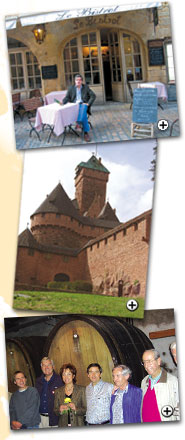
drive through the Alsace wine route and head for Ribauville where we'll visit the Chateau du
Haut-Koenigsburg; a very famous 12th Century medieval chateau. We'll have a visit and
degustation at the Domaine Weinbach winery at Kayserberg; owned by the Faller family. Returning
to the Maison des Têtes Hotel, we'll have dinner at the hotel's restaurant.

Awe-inspiring Alsace
Noted for its wines, the principal cities of Alsace are Colmar, Mulhouse and the regional
capital of Strasbourg; the city where Gutenberg invented the movable letterpress. Much of the
region is found on a fertile alluvial plain that honors the all-important French notion of
terroir, or native soil. An improbably beautiful place, it lies between the Rhine River and the
Vosges mountains to the west. Alsace is a region sure to be mentioned whenever the French talk
about their gastronomy, art, history and culture.
The region enjoys a semi-continental climate with hot summers and long warm autumns, ideal for
market gardeners and wine growers. Alsace [and Lorraine] is unique among French regions, due to
its dual Franco-Germanic cultures. The majority of the population speaks French with a decided
German accent and a cuisine that is a wonderful blend of French and German cooking.
|