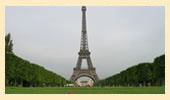
The secret of eternal youth. Visit places that do not change. Keep looking back for memories.
Use all your senses to project yourself into the past: its music-noise, smells- aromas,
pictures-letters, tastes-flavors.) See the future as an extension of your past.
Quite a few months have gone by since my last newsletter and I have tried to analyze the
reasons why I have been silent for so long. The only one I can come up with is to blame time.
Is this really what it is or procrastination or lack of inspiration? I will be honest. It is a
little bit of all the above. Writing is like exercising. If you don't do it on a regular basis,
you start losing your sharpness. Today, I decided to put an end to this drought, regain my focus
and share some of my reflections with you.
Every time I return from my summer vacations in France, I feel rejuvenated. As I wrote in one of
my past newsletter, one aspect the French have learned to master is to deal with time. I am sure
some of you have read the book, "A Year in Provence" in which the characters experienced extreme
frustration because the contractors never showed up the day they were supposed to come (sounds
familiar.) That sense of urgency, however, is not a priority for the French, especially when it
relates to time, i.e. quality of life. I have often heard this famous line," If it cannot be done
today, it will be done tomorrow." After all, stopping for a two hour lunch break is more important
than using these same two hours to frantically finish a job on time. "There is always another day."
This is probably why so many Americans love to visit France. For once they are not in control of
time but rather time dictates a pace of life that forces them to slow down and be in the present -
and there is nothing they can do about it. Meals take much longer because the French know this
is not only a time to eat but also to enjoy and celebrate being with friends and family.
Another aspect of the French philosophy that is unique and reassuring is the fact that many things don't
change. Some might argue France is part of "Old Europe" and consequently slow to change. I might add
that before you get old, you are young. This is how you acquire wisdom and experience. This is what I
love about the French culture! Some things never change. Think of Paris. In a sense it is an old city
and we love it for what it is! The core of the city is always the same. It has kept the same historic
architecture of its buildings, its atmosphere and its authenticity. You can visit Paris a hundred times
and will always find the same buildings, streets, shops, restaurants and cafés. Have you ever been to a
Parisian brasserie, year after year, and realize the room, tables, chairs, menus and even the wait staff
are always the same? Even some menus offer the same traditional classical French cuisine such as Cassoulet,
confit de canard, salade au Chèvre chaud, petit salé, sole meunière, crème caramel etc. Why do we enjoy
spending so much time in France? As I mentioned earlier, it is familiar and predictable and more
importantly, the warm, comforting feeling it offers because things have not changed. This gives us
reassurance that we have not changed either. We still belong to the things of the past. If things stay
the same we like to think we do, too. It is essential to go back to the places that are linked to good
memories. Every Summer since I was born, I have spent at least two to four weeks in our family house in
Normandy. This is also why I feel rejuvenated when I come back to United States. Because all my memories
come back at once, I suddenly feel I never stopped being young. This is the secret to age and staying young.
__________
A while ago I came across an interesting article in the food section of a local newspaper describing
the nerve wracking dilemma in going out to dinner with friends when the time comes to settling the bill.
I am sure you have experienced similar knots in your stomach when dealing with this touchy subject. It
starts from the first minute you go out with friends until the moment you are heading back home, all the
while commenting about the fact that the bill was split equally and not fair. For example, the entree you
picked was less pricey than the one chosen by your friends, the wine was ordered but you did not drink wine
and everybody had a dessert but you. Naturally, the easiest route to take is to split the bill. Is that fair?
I would say probably not. I have found it very uncomfortable and embarrassing, however, that at the end of a
dinner, someone has to take out a calculator to figure out the exact amount, to the penny, of what each guest
has ordered. This can create a diplomatic incident. Is there a solution to solve this delicate issue? One
alternative is to invite your friends to come over to your house, instead, and ask every person to bring an
appetizer, main dish, dessert and a bottle of wine. Of course, I am not serious and will address this scenario
in my next newsletter. The other option is that when you go out with friends, simply pick up the tab for the
entire table and have a big smile. Next time you go out with the same friends, they will happily reciprocate
and take their turn to pay the bill, also with a big grin. Ultimately if you are with good friends it should
not be an issue; you equally split the bill, otherwise what value do you attach to your friendship? Finally,
the French have resolved part of this conundrum by having both a fixed price meal on their menu and "a la
carte". It goes without saying that if one orders the fixed menu, most of the people around the table will
very likely do the same. Ultimately it comes down to the "Savoir Vivre"; consideration for the people around
the table and a bit of common sense. "L'addition s'il vous plait!"
|